
Why Galaxy S26 Ultra’s Larger Aperture Is a Liability, Not an Advantage, without the “Frankenstein Move”
The Galaxy S26 Ultra’s ISOCELL HP2 f/1.4 sensor sounds… boring. Same HP2 200MP sensor. Same ~1/1.3″ size. Just a new, larger f/1.4 aperture lens. Most “showroom” reviews will quickly label this as a software refresh. But there’s more to the story.
Disclaimer: This article is not a leak — it’s an engineering and product-strategy analysis. Once you look at the physics and the cost structure, that simple story no longer holds up. Because moving to f/1.4 changes everything.
Why “same sensor” doesn’t mean the same silicon
Samsung isn’t reusing old ISOCELL HP2 wafers from previous years. Each new Ultra generation requires a fresh production run — meaning new wafers and, critically, the opportunity to revise the physical mask. Samsung doesn’t need to create a brand-new sensor family. But printing an unchanged mask while changing the optical system would make little sense.
This is where lithography-level refinement becomes both possible and logical. The Galaxy S26 Ultra’s 200MP primary camera doesn’t have a new sensor, but a rebuilt one.
The f1.4 sensor becomes a liability without the Frankenstein move
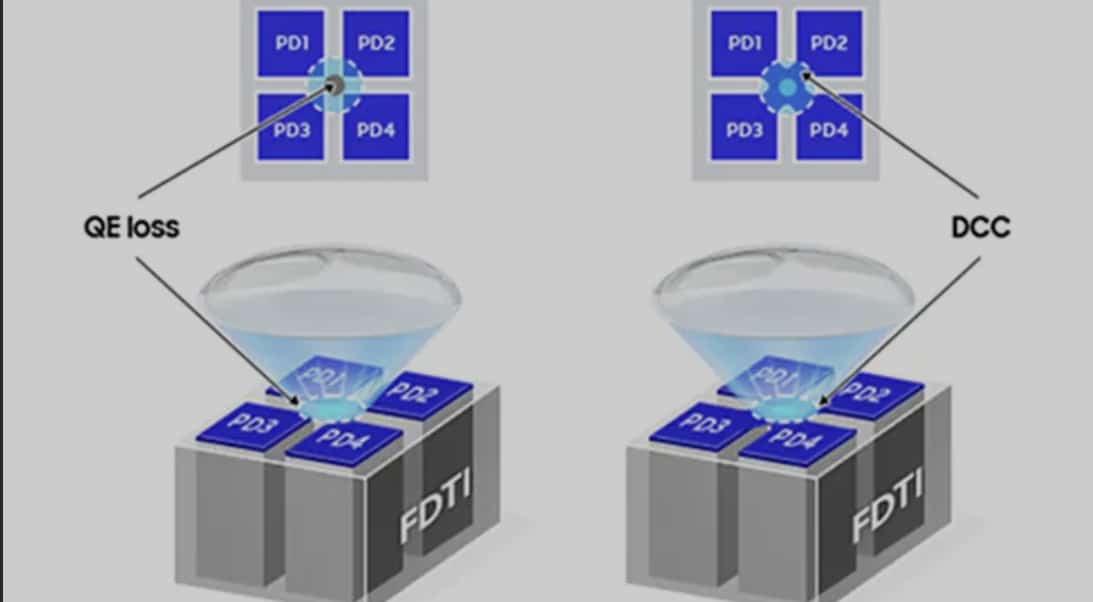
An f/1.4 lens isn’t just “brighter.” It introduces much steeper chief ray angles, especially toward the edges of the sensor. This is where older isolation designs on the ISOCELL HP2 begin to struggle:
- Steep-angle photons are more likely to leak into neighboring pixels
- Crosstalk increases
- Edge image quality degrades
Without proper handling, moving to f/1.4 risks visible image regressions rather than improvements.
It’s also important to be clear about the limits of software. Lens coatings, computational photography, neural engines, or even ND filters can reduce reflections, smooth noise, or limit exposure, but they cannot change light geometry or pixel isolation once photons hit the sensor. This limitation becomes far more visible in video than in photos, where real-time capture leaves no room to “fix” crosstalk after the fact.
Is there a solution? Let’s break that down
The blueprint: Lessons from the HP5 200MP
Samsung’s own sensor roadmap already shows the direction its imaging technology is moving. The ISOCELL HP5, despite being much smaller (~1/1.56″), introduced a combination of technologies designed to help extremely small pixels survive:
- Dual Vertical Transfer Gate (D-VTG) to increase Full Well Capacity (FWC)
- Front Deep Trench Isolation (FDTI) combined with center-cut DTI (DCC) to improve pixel isolation, autofocus stability, and signal cleanliness
- Conversion gain enhancements enabled by the DTI center-cut refinement
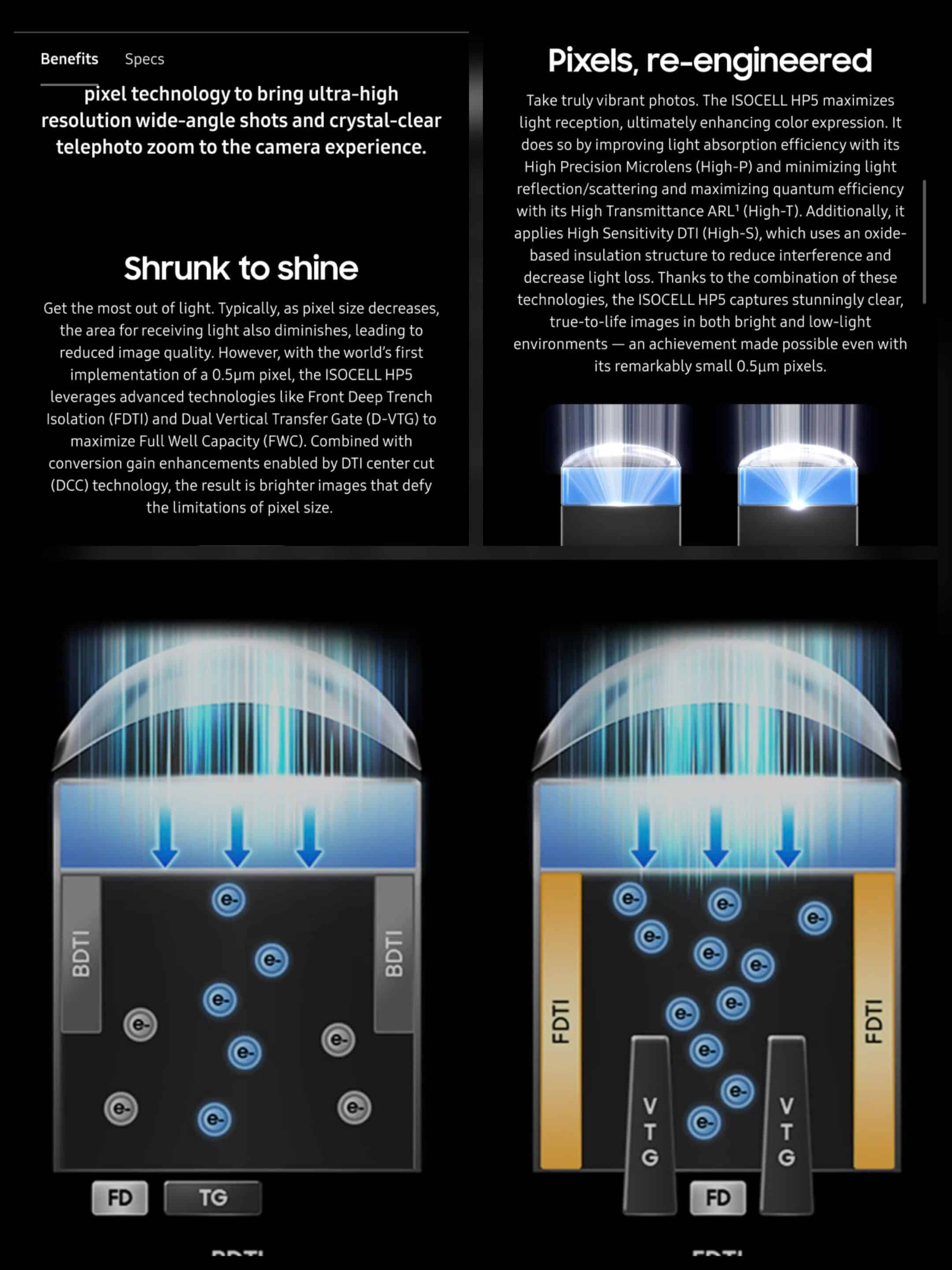
These technologies were developed to protect ~0.5µm pixels from crosstalk and charge leakage. The HP5 itself is too small for the Ultra series, but the isolation and charge-management strategy is not size-limited. Which raises a simple question: Why not apply that approach to a larger-pixel sensor?
A quick historical reality check
To keep expectations grounded, it’s important to separate what Samsung has already done from what this analysis suggests may come next. The Galaxy S23 Ultra introduced the original ISOCELL HP2 with D-VTG, a major step forward for charge capacity and low-light performance at 0.6µm pixels.
The Galaxy S24 Ultra and S25 Ultra continued to use refined versions of the same HP2 architecture, with incremental tuning and yield improvements, but without center-cut DTI (DCC), as the optical system remained at f/1.7.
In other words, D-VTG is already part of the HP2 lineage. What has not yet appeared at this sensor size is HP5-style DTI center-cut refinement. That’s why the rumored move to f/1.4 matters.
The “backport” strategy: Rebuilding the HP2
Rather than designing an entirely new sensor, the most logical path forward is a backport strategy. This is where the “Frankenstein” theory comes in. Samsung could combine:
- The body: HP2’s larger ~0.6µm pixels, which naturally collect more light and fit the Ultra chassis
- The brain: HP5-style isolation refinement — using FDTI-based structures with center-cut DTI (DCC) — to improve charge separation, angular tolerance, and readout cleanliness
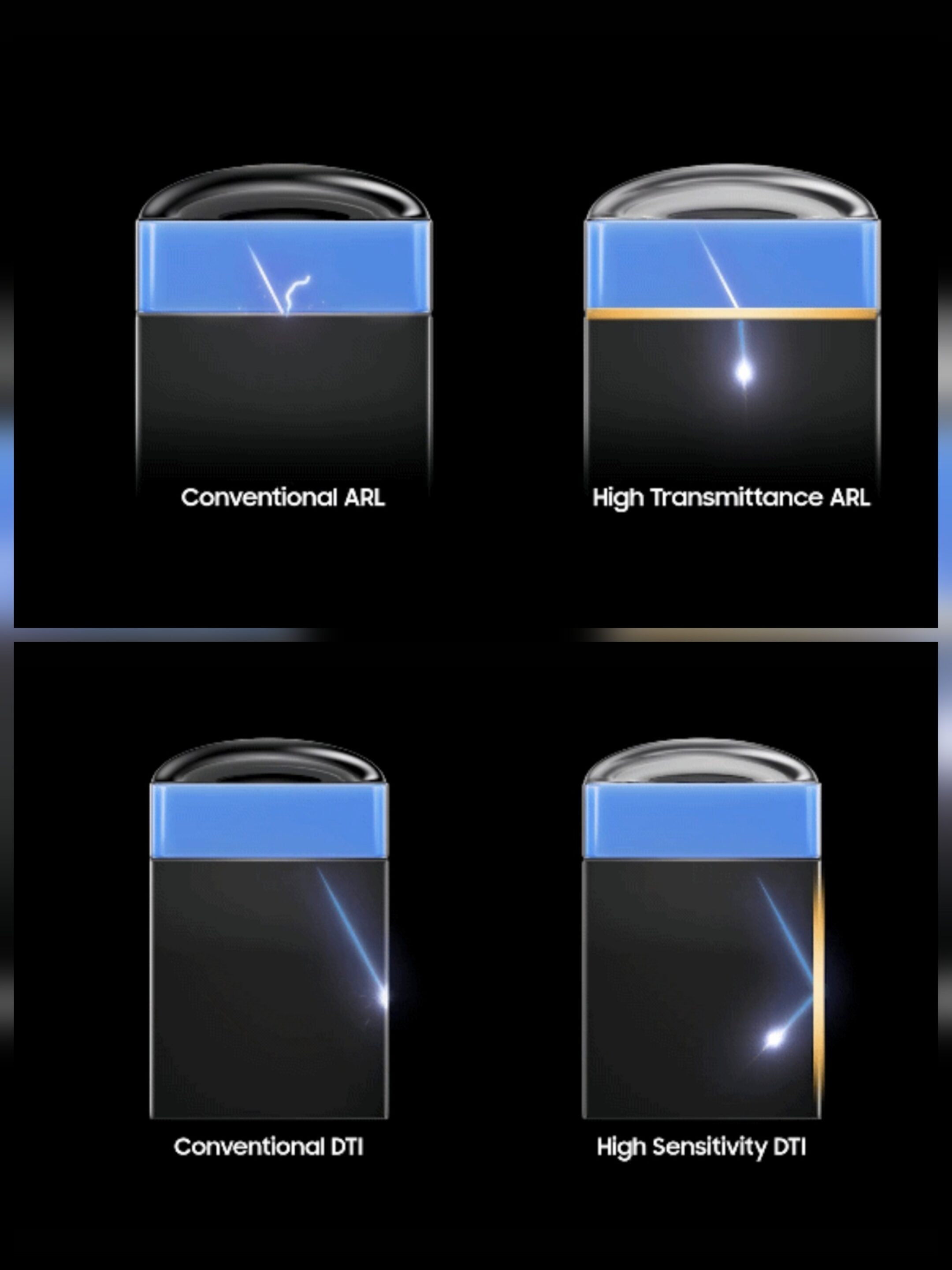
The result wouldn’t turn the HP2 200MP into a new sensor class. But it could meaningfully improve effective conversion gain, Full Well Capacity behavior under stress, and edge performance, especially with an aggressive f/1.4 light cone.
Center-cut DTI doesn’t block light — it controls where the charge ends up. When paired with updated microlens shaping and CFA tuning, it allows more of that f/1.4 light to reach the photodiode instead of degrading the signal. Without this refinement, f/1.4 becomes a liability rather than an advantage.
This also makes sense as a business decision
There’s another layer to this story: cost efficiency. Samsung Mobile (MX) and Samsung Semiconductor (LSI) operate as separate divisions with independent budgets. Sensor choices aren’t just engineering decisions, but they’re also product-strategy decisions.
From that perspective, moving to a much larger sensor would require major chassis changes and risk core Ultra features. Jumping to an f/1.4 lens without sensor-level changes, on the other hand, risks visible regressions and negative reviews. Refining the HP2 through an updated lithography mask is a controlled, one-time investment.
It leverages a mature manufacturing process, avoids sourcing an entirely new sensor, and protects image quality without redesigning the phone.
- LSI keeps its HP2 production line relevant
- Samsung Mobile gets an upgraded sensor without paying “new sensor” prices
That’s not a luxury expense — it’s risk management
Marketing will likely call this “Enhanced Nightography.” Physics calls it a lithography revision.
The Galaxy S26 Ultra may still carry the HP2 name, but that doesn’t mean the silicon beneath it is unchanged. Think of it as the same engine block, rebuilt with stronger internal components to handle higher stress.
It’s not a 1-inch sensor. It’s not LOFIC. But a D-VTG + FDTI + center-cut DTI (DCC) refined HP2 would be a textbook example of extracting real performance gains from an existing architecture without chasing spec-sheet theater. Samsung can make the Frankenstein move or accept the risks of f/1.4 or something else. We’ll only know at launch.

Follow us on Google Discover & set us as a preferred source in Google News
Share this Post
___________________________


New Blog Posts
___________________________
First Set of Pixel 11 Pro XL Renders Are Here
Pixel 11 Pro XL CAD renders show minimal design changes

Is Samsung Preparing One UI 8.5 Beta for Galaxy Z Fold 5 and Flip 5?
Samsung may launch a One UI 8.5 beta program for its 2023 foldables
Galaxy S25 One UI 8.5 Beta May Run Longer Than Expected
Galaxy S25 series’ One UI 8.5 beta may stretch to 10 rounds