Samsung Display Showcases 20,000 Nits OLEDoS for XR Headset
SammyGuru is reader-supported. We have affiliate and sponsored partnerships, so we may earn a commission when you buy through links on our site — at no extra cost to you. Learn more.
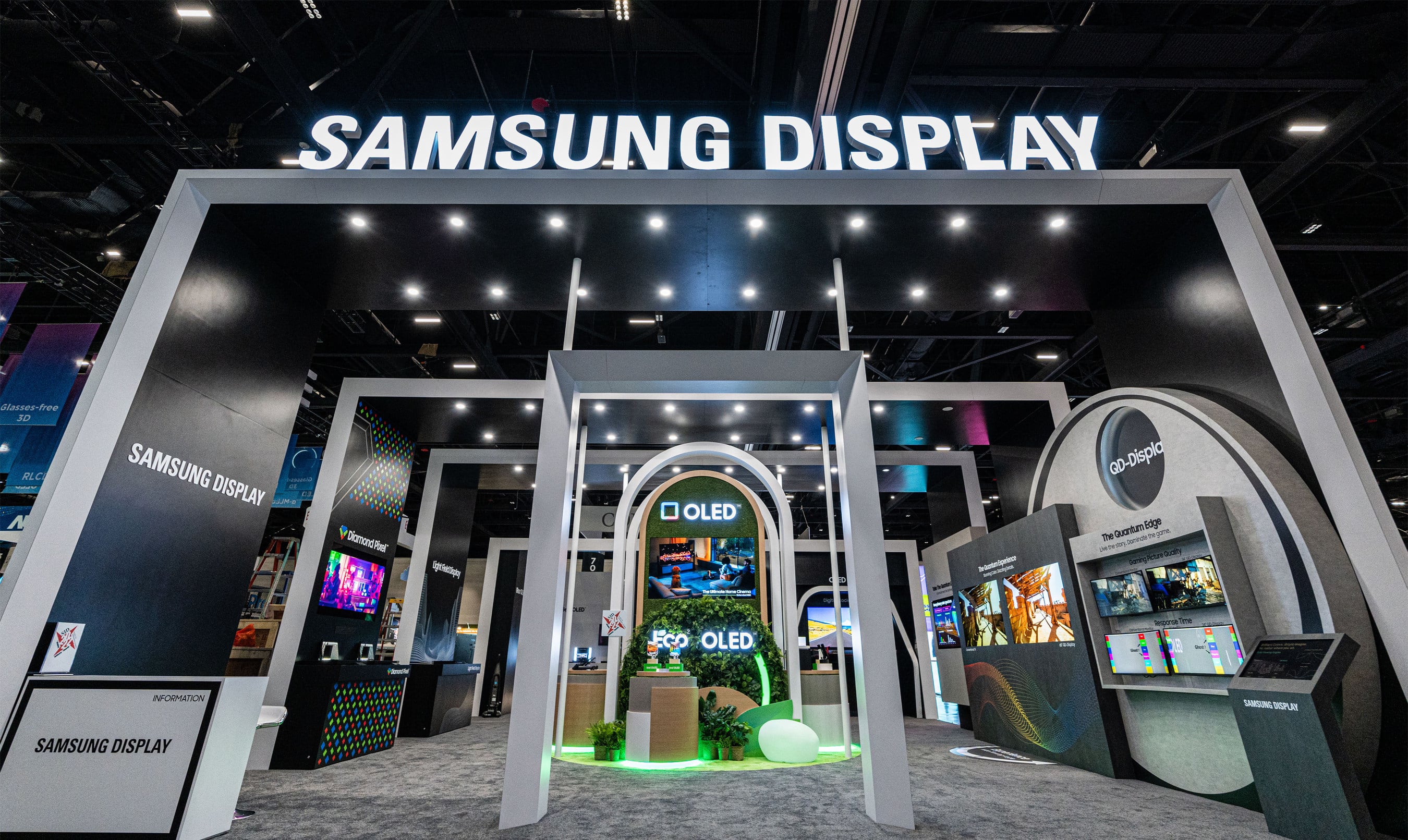
Samsung Display, a global leader in the display industry, has been showcasing its advanced OLEDoS (OLED-on-Silicon) technologies at global exhibitions. After the recent Display Week 2025, the company participated in the AWE USA 2025 event to exhibit its display innovations. It presented XR headset-ready OLEDoS screens with a peak brightness of 20,000 nits.
Samsung highlights RGB and White OLEDoS innovation at AWE USA 2025
AWE USA is a leading global event for the XR (Extended Reality) industry, which includes AR (Augmented Reality), VR (Virtual Reality), and MR (Mixed Reality). The 2025 event kicked off on June 10 and will run through June 12 in Long Beach, California. Samsung Display participated in the event to showcase its flagship products: RGB OLEDoS and White OLEDoS.
“Technological innovations driving spatial computing are advancing more dynamically than ever,” said Jae Beom Choi, Executive Vice President and Head of M-P/J Division at Samsung Display. “Through our participation at AWE, we aim to showcase the vast potential of OLEDoS to consumers and reinforce our position as a key partner in the spatial computing ecosystem.”
Among the many OLEDoS panels, a 1.3-inch RGB OLEDoS panel took the center stage. Designed for XR headsets, the screen offers a resolution of 4,200 PPI and a peak brightness of 20,000 nits. To achieve this, Samsung implemented Micro Lens Array (MLA) technology that uses the principles of convex lenses for improved brightness and viewing angle. This marks significant progress in the display industry — the Korean firm’s earlier versions include a 5,000 nits and 10,000 nits panel.
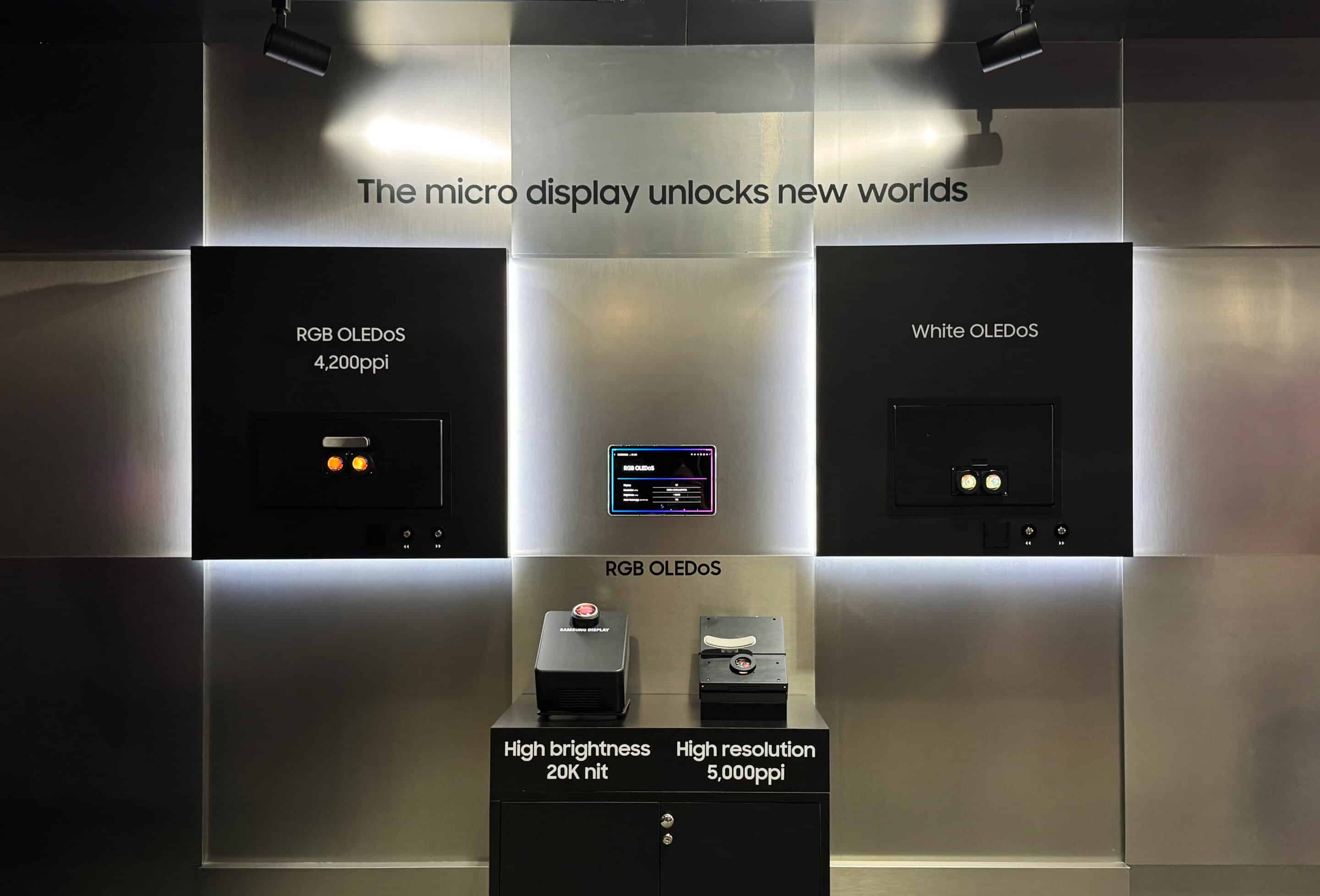
Showcased industry-leading RGB OLEDoS
The company also showcased its 1.4-inch RGB OLEDoS panel that offers an industry-leading resolution of 5,000 PPI. Even though it’s small in size, it has three times more pixels than a 4K TV, enhancing visual clarity. Meanwhile, eMagin, a subsidiary of Samsung Display, also presented its OLEDoS microdisplays, including White OLEDoS and RGB OLEDoS. Both displays are 0.62 inches in size and have a pixel density of 2,600 PPI.
At AWE USA 2025, Samsung also let visitors participate in immersive binocular demonstrations for real-world headset experiences. Basically, Samsung Display aims to cater to the fast-growing XR market, which is estimated to rise from about $600 million in 2025 to $4.1 billion by 2030.

Written by
Binay KonwarBinay Konwar started his blogging journey in 2014 and has since written plenty of tech articles. At present, he is working as a News Writer at SammyGuru, covering everything about Samsung. He holds a Master's degree in Mathematics, but his real passion lies in tech and writing. In his free time, he enjoys playing chess and watching movies.

Follow us on Google Discover & set us as a preferred source in Google News
Share this Post
___________________________


New Blog Posts
___________________________
First Set of Pixel 11 Pro XL Renders Are Here
Pixel 11 Pro XL CAD renders show minimal design changes

Is Samsung Preparing One UI 8.5 Beta for Galaxy Z Fold 5 and Flip 5?
Samsung may launch a One UI 8.5 beta program for its 2023 foldables
Galaxy S25 One UI 8.5 Beta May Run Longer Than Expected
Galaxy S25 series’ One UI 8.5 beta may stretch to 10 rounds