Samsung Continues to Lead SSD Market, But Rivals are Catching up
SammyGuru is reader-supported. We have affiliate and sponsored partnerships, so we may earn a commission when you buy through links on our site — at no extra cost to you. Learn more.
Samsung’s memory business continues to see solid growth thanks to increasing demand for AI-powered data storage. The company secured the top spot in the enterprise SSD (solid state drives) market in the fourth quarter of 2025. This shows the strength of its vertically integrated business model that helps fulfill enterprise demand.
Samsung’s vertically integrated SSD strategy played a key role in solid growth
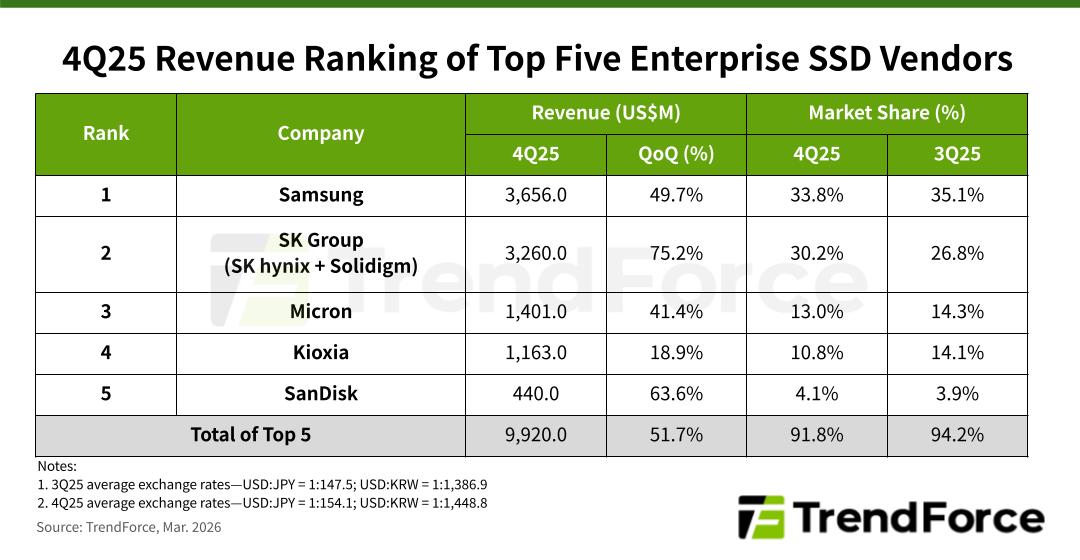
According to data from TrendForce, Samsung led the enterprise SSD market with revenue of about $3.66 billion in Q4 2025. This is a 49.7% increase compared to Q3 2025, which is quite impressive. However, market share (QoQ) dropped from 35.1% to 33.8%. The company’s solid performance is likely the result of the recent increase in enterprise adoption of SSDs to support AI inference workloads.
Furthermore, Samsung likely saw an increase in demand thanks to shortages of hard disk drives (HDDs). This prompted several companies to switch to SSD solutions. The company’s ability to make its own DRAM and NAND Flash memory ensures a stable supply even as concerns about possible DRAM shortages rose.
TrendForce says Samsung’s 176-layer QLC enterprise SSD lineup could see significant shipment growth in 2026. This could further solidify the firm’s position in the enterprise SSD market. However, the company has begun seeing stiff competition from its rival SK Group.
SK Group (including SK hynix and Solidigm) performed quite well in Q4 2025, both in revenue and market share, maintaining the second position. Its revenue increased 75.2% QoQ, while the market share grew from 26.8% to 30.2%. Solidigm continues to focus on high-capacity QLC SSDs, which are increasingly in demand for large-scale data storage.
Meanwhile, Micron came in the third spot with a market share of 13% and revenue growth of 41.4% QoQ. The company’s decision to focus on high-margin enterprise SSDs rather than consumer products paid off. Kioxia and SanDisk held the fourth and fifth spots, with market shares of 10.8% and 4.1%, respectively.

Written by
Binay KonwarBinay Konwar started his blogging journey in 2014 and has since written plenty of tech articles. At present, he is working as a News Writer at SammyGuru, covering everything about Samsung. He holds a Master's degree in Mathematics, but his real passion lies in tech and writing. In his free time, he enjoys playing chess and watching movies.

Follow us on Google Discover & set us as a preferred source in Google News
Share this Post
___________________________


New Blog Posts
___________________________
First Set of Pixel 11 Pro XL Renders Are Here
Pixel 11 Pro XL CAD renders show minimal design changes
Is Samsung Preparing One UI 8.5 Beta for Galaxy Z Fold 5 and Flip 5?
Samsung may launch a One UI 8.5 beta program for its 2023 foldables
Galaxy S25 One UI 8.5 Beta May Run Longer Than Expected
Galaxy S25 series’ One UI 8.5 beta may stretch to 10 rounds