
Zoom Battle 2026: Oppo on Top — Samsung, Xiaomi & Vivo Fight, iPhone Lost
The zoom battle in 2026 is no longer about who has the biggest sensor or the highest megapixel count. Every flagship now promises “AI zoom,” “optical quality,” and “DSLR-like results.” Yet real-world usage tells a very different story. To understand who is actually winning — and why — we need to stop reading spec sheets and start analyzing engineering decisions.
Disclaimer: This article is based on current leaks, supply-chain information, and engineering analysis available at the time of writing. Final hardware and software behavior may differ at launch.
The telephoto “brain” engineering, not marketing
Modern telephoto performance is not decided by megapixels or sensor size alone. It is the result of three brains working together, each with a specific responsibility:
- Sensor Brain — On-sensor physics, pixel structure, full-well capacity, readout behavior
- Company Brain — SoC, ISP, NPU, and custom imaging silicon philosophy
- Software Brain — Frame fusion, stabilization, reconstruction, AI intervention
When these three brains are aligned to clear distance (magnification) roles, a telephoto system behaves naturally. When they are not, quality collapses, regardless of how impressive the specs look on paper. Let’s start with the devices already on the market.
Apple’s philosophy: One lens, one role
Apple believes in discipline: one telephoto lens, one focal length, one predictable behavior. On paper, this approach is clean. In daily life, it has become a limitation.
Don’t get me wrong, Apple’s 4× tetraprism camera on the iPhone 17 Pro / Pro Max is technically strong at its intended distance.
- Sensor Brain: Dual-layer stacked sensor with fast readout, tuned for stability rather than close focus
- Company Brain: A19 Pro ISP tightly integrated with the Neural Engine for predictable, hardware-level processing
- Software Brain: Photonic Engine, Smart HDR, and Deep Fusion prioritize controlled output over aggressive reconstruction
At true optical distances, results are clean, stable, and color-accurate. However, the latest iPhones suffer from distance locking. The system fails not because the sensor is weak, but because one lens is forced to cover too many scenarios. The 4× telephoto has a very long minimum focus distance (~85–100 cm), which is impractical for: Portraits, Food and pets, Indoor scenes
When users tap 4× at closer distances, the phone silently switches to the main camera and digitally crops — with no warning and no option to disable it. This gives the user the perception that the 4× zoom camera is bad, but in engineering reality, the telephoto lens was never used.
Long-range limitation
With only one telephoto lens, Apple is forced into digital zoom beyond 4× ~ 8×. Apple deliberately avoids aggressive AI reconstruction, preserving a natural look — but this conservative approach means long-range detail cannot compete with dual-telephoto systems that maintain more optical coverage or rely on high-resolution data.
Technically strong, but practically failed.
Xiaomi’s philosophy: Optical complexity as strategy
Xiaomi takes the opposite approach. Instead of limiting the telephoto’s role, it builds one of the most complex mobile telephoto systems ever attempted. The Xiaomi 17 Ultra has a Leica 200MP Variable Telephoto lens (~75–100mm | 3.1×–4.3×). And no, this is not a crop, but true variable optical zoom.
- Sensor Brain: Large 200MP ~1/1.4″ sensor with high full-well capacity, used across the optical range
- Optical Brain (Key Advantage): Leica APO optics with three independently moving lens groups enable real optical zoom from 75mm to 100mm — no digital cropping
- Company Brain: Snapdragon 8 Elite Gen 5 ISP combined with Xiaomi’s high-throughput imaging pipeline
However, even with this optical sophistication, physics still applies. Beyond 100mm, Xiaomi runs out of glass and must rely increasingly on AI reconstruction. Processing load rises, temporal stability drops, and long-range zoom becomes more computational than optical.
A bold and complex optical achievement. Highly flexible, but even a variable lens cannot fully replace a dedicated long-range telephoto.
Samsung’s philosophy: Divide the job, reduce the risk
Samsung refuses to build one telephoto lens to do everything. Instead, it splits responsibilities clearly to reduce compromise. All leaks point to a dual (3x and 5x) zoom setup on the upcoming Galaxy S26 Ultra.
3× Telephoto (~72mm)
Sensor Brain: Native 12MP sensor (S5K3LD), no Quad-Bayer, no binning — large effective pixels
The S5K3LD seen in software leaks may not be the same 1/3.94″ sensor often linked to the S5K3K1. This is based on analysis, not confirmation. Full breakdown is linked on my X.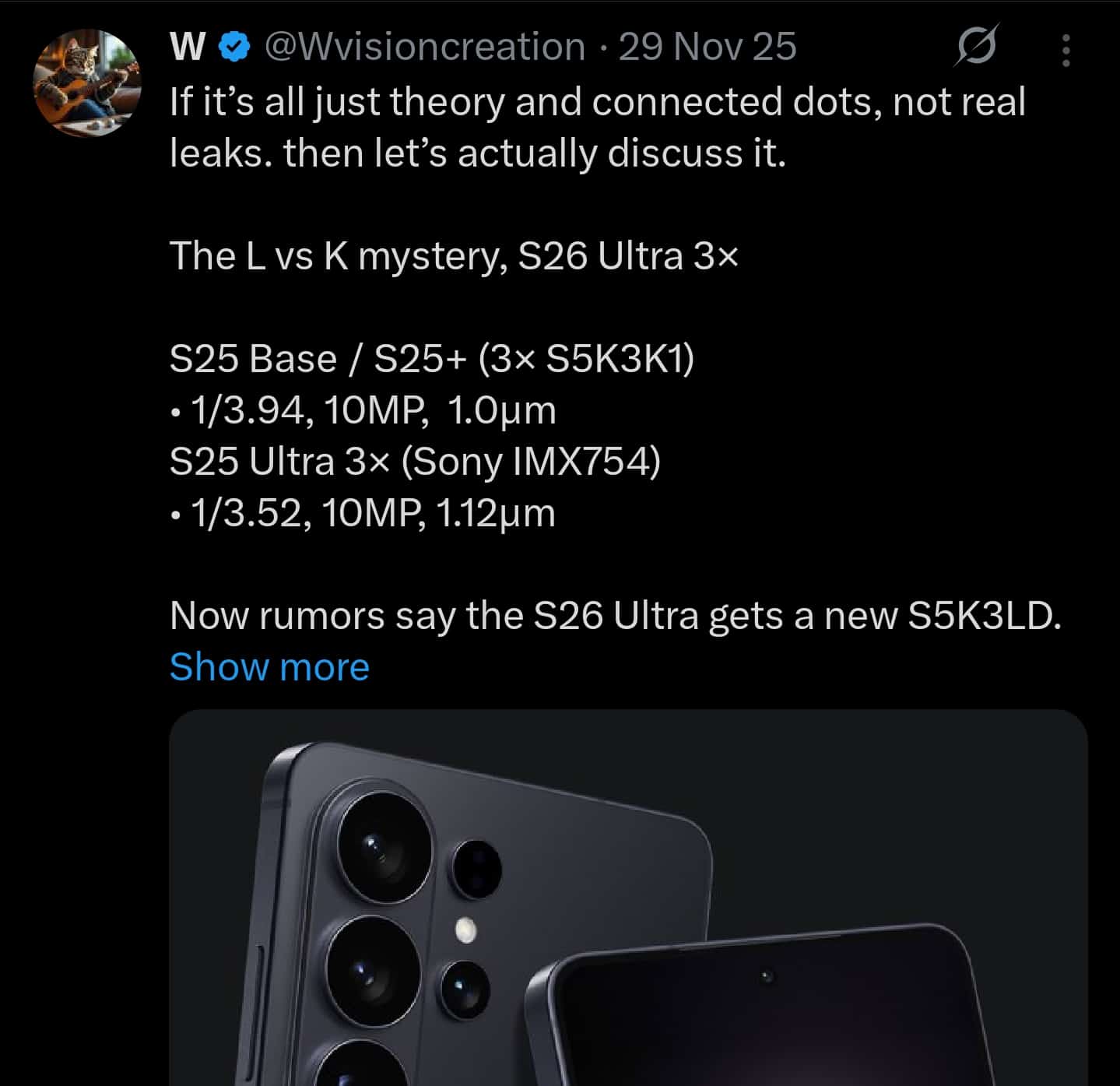
Strengths :
- High micro-contrast, fast autofocus, and short minimum focus distance (~18–25 cm)
- From 3× to ~4.9×, a native optical lens with good sensor technology can deliver cleaner texture and more stable video than high-resolution binning or crops — if the sensor is good enough
5× Periscope (~120mm, based on leaks)
This is where Samsung knowingly steps into dangerous territory. The Galaxy S26 Ultra’s 5× periscope is rumored to move from 115mm to 120mm and adopt a brighter f/2.9 aperture on a standard single-layer stacked sensor, putting bright optics on a standard sensor. As discussed in the Frankenstein Theory, pairing a bright aperture with a non-dual-layer stacked sensor introduces real risks:
- Light leakage between pixels
- Crosstalk at telephoto angles
- Micro-jitter amplification in video
Sony’s IMX854 cannot solve this at the sensor level. Samsung knows this and aims to fix it with software. The company does not fight physics with glass. It fights physics with computation.
- Software Brain: Neural Frame Engine
- Maps micro-jitter across frames
- Detects pixel-level crosstalk
- Corrects light leakage temporally
- Stabilizes motion before reconstruction
This is not sharpening or denoising. It is real-time temporal correction, designed specifically to mask the weaknesses of bright periscope optics. Samsung accepts optical limitations and masks them computationally. That’s intentional, cost-aware, controllable engineering.
Vivo’s philosophy: Optics first, software later
Vivo pushes optical design harder than any other brand. Based on Vivo X300 Ultra leaks (~85mm, 200MP HPE), it lets the lens do the work.
- Sensor Brain: Large 200MP HPE telephoto sensor with high capacity
- Optical Brain: Zeiss APO floating lens system with real mechanical focus travel
The result is an extremely short minimum focus distance, making it a true tele-macro specialist. At optical distances, results are clean and natural. However, at long range, Vivo must rely on aggressive AI reconstruction once optics reach their limit, a similar issue seen with Xiaomi.
Outstanding for portraits and tele-macro. AI-dependent at long range.
Oppo’s philosophy: Balance over brilliance
The quiet engineering leader Oppo does not chase extremes. Instead, it builds the most balanced telephoto system on paper. The Find X9 Ultra is expected to feature a dual telephoto system. A 3x lens optimized for portraits and daily use, and a 10x periscope lens for dedicated long-range optical zoom.
- Sensor Brain: Two dedicated telephoto sensors, each optimized for its focal length
- Company Brain: Balanced ISP strategy focused on consistency rather than extreme reconstruction
With this setup, Oppo leads zoom photography, at least on paper. Clear role separation, minimal AI dependency, and practical minimum focus distances. Oppo may not be the loudest, but it is the most complete.
To sum it up:
- Apple prioritizes predictability — but loses flexibility
- Xiaomi and Vivo push optics to the limit — and pay the price at long range
- Samsung manages risk through computation — balance will decide success
- Oppo quietly avoids compromise altogether
Of course, real-world testing will decide the final winner. But the best telephoto system in 2026 will surely not depend on the biggest sensor or the highest megapixel count. It is the one where Sensor Brain, Silicon Brain, and Software Brain are aligned to specific distance roles.

Follow us on Google Discover & set us as a preferred source in Google News
Share this Post
___________________________


New Blog Posts
___________________________
First Set of Pixel 11 Pro XL Renders Are Here
Pixel 11 Pro XL CAD renders show minimal design changes
Is Samsung Preparing One UI 8.5 Beta for Galaxy Z Fold 5 and Flip 5?
Samsung may launch a One UI 8.5 beta program for its 2023 foldables
Galaxy S25 One UI 8.5 Beta May Run Longer Than Expected
Galaxy S25 series’ One UI 8.5 beta may stretch to 10 rounds