
Samsung Leads Southeast Asia Smartphone Market in Q1 2025

SammyGuru is reader-supported. We have affiliate and sponsored partnerships, so we may earn a commission when you buy through links on our site — at no extra cost to you. Learn more.
Samsung’s smartphone business has had a solid first quarter of 2025. The company led the global market, reclaiming the top spot in Southeast Asia in the process. It rode on the back of the Galaxy S25 flagships and the Galaxy A series to emerge as the top smartphone vendor in the region.
Samsung achieved the top position with a 19% market share
According to Canalys (now part of Omdia), Southeast Asia’s smartphone market declined by 3% to 22.8 million shipments in Q1 2025. This is the first drop after five consecutive quarters of annual growth. Due to inflationary pressures, the market saw a lower demand, mainly in the entry-level and mid-range segments.
Samsung also suffered a decline, shipping 4.3 million smartphones in Q1 2025, which is less than the 4.5 million shipments around the same time last year. However, the company maintained its market share at 19%, the same as in the previous year. These strong figures helped it to secure the top position in the region.
It’s worth noting that Samsung was the market leader in Southeast Asia for several years until Q2 2024. In Q3 and Q4, it lost the top spot to Oppo and Transsion, respectively. In fact, Samsung dropped to the fourth spot in the year-ending quarter, with Xiaomi leapfrogging it. The Korean firm has now reclaimed the crown.
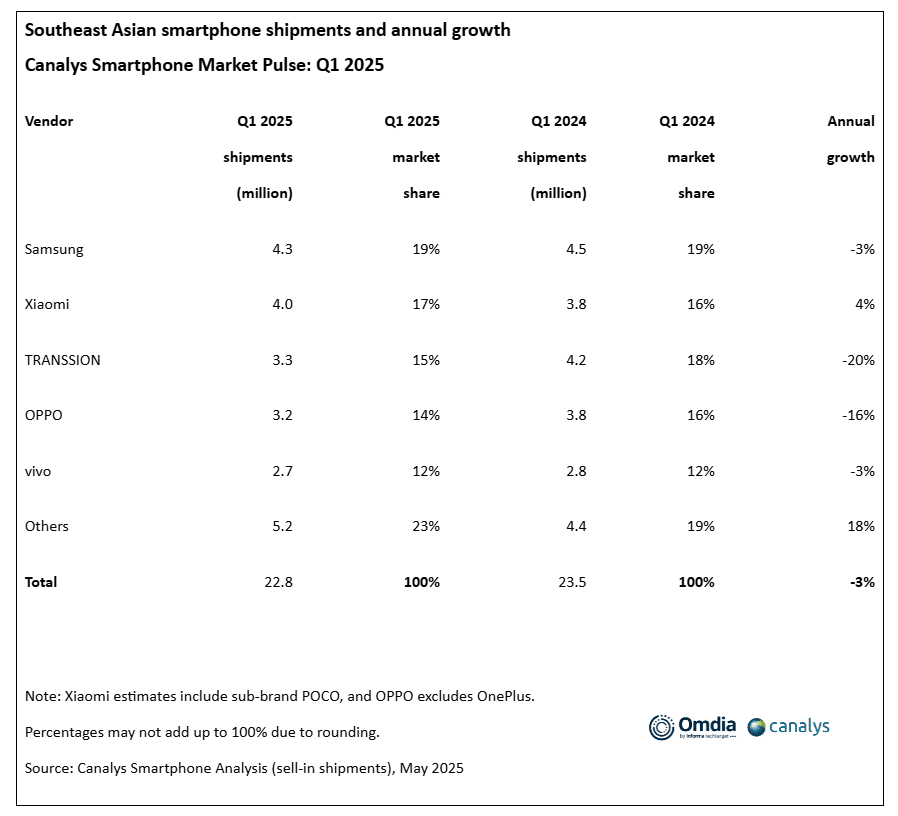
“Samsung has traditionally led in the 5G-capable device segment and its focus on delivering improved value and deepening telco partnerships has paid off,” said Canalys Senior Analyst Sheng Win Chow. The company saw strong performance due to high sales of its popular 5G Galaxy A series models, which increased by 47% compared to last year.
Samsung aims to sell high-end smartphones in the market and move away from the entry-level segment. And the recent growth shows the company is on the right track, despite current challenges in the ultra-low-end market.
As of now, the smartphone market in Southeast Asia is encountering many challenges, such as global trade tensions, currency fluctuation, political uncertainty, and inflation. Higher costs for imports will force the brand to increase the price of smartphones. However, Samsung has an opportunity to cater to the market as a large portion of smartphone production occurs in Vietnam.

Written by
Binay KonwarBinay Konwar started his blogging journey in 2014 and has since written plenty of tech articles. At present, he is working as a News Writer at SammyGuru, covering everything about Samsung. He holds a Master's degree in Mathematics, but his real passion lies in tech and writing. In his free time, he enjoys playing chess and watching movies.

Follow us on Google Discover & set us as a preferred source in Google News
Share this Post
___________________________


New Blog Posts
___________________________

First Set of Pixel 11 Pro XL Renders Are Here
Pixel 11 Pro XL CAD renders show minimal design changes

Is Samsung Preparing One UI 8.5 Beta for Galaxy Z Fold 5 and Flip 5?
Samsung may launch a One UI 8.5 beta program for its 2023 foldables
Galaxy S25 One UI 8.5 Beta May Run Longer Than Expected
Galaxy S25 series’ One UI 8.5 beta may stretch to 10 rounds