
Samsung Exynos 2500 Fails to Impress — Underperforms in Benchmarks
After a long delay, Samsung’s first-ever 3nm smartphone processor, the Exynos 2500, is finally making its debut later this summer. The chip will power the upcoming Galaxy Z Flip 7, making it the first foldable to feature an Exynos chipset. A benchmark listing recently offered an early look at its performance, and it’s not entirely encouraging. The Exynos 2500’s Geekbench 6 scores fall well below current flagship standards.
Exynos 2500 has a weak showing for a 3nm chip
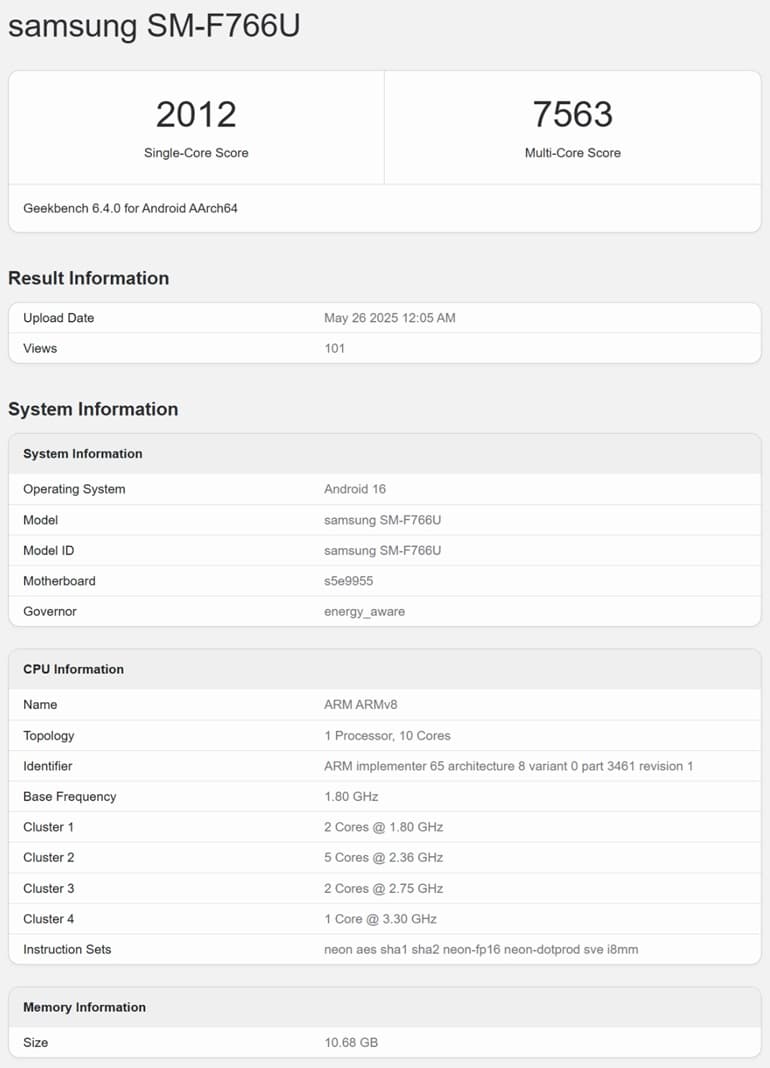
The Exynos 2500 scored 2,012 points in single-core and 7,563 points in multi-core tests on Geekbench v6.4. When compared to recent flagship chipsets from other companies, like Apple’s A18 Pro, MediaTek’s Dimensity 9400, and Qualcomm’s Snapdragon 8 Elite, the Exynos 2500 appears to underdeliver, especially disappointing given that it’s the first smartphone chip manufactured on Samsung’s 3nm GAA process.
Even Xiaomi’s newly announced custom flagship chip, Xring 01, surpasses the Exynos 2500 in raw performance, making this debut all the more underwhelming. The new Samsung processor also has a deca-core CPU setup, featuring one Cortex-X925 core at 3.3GHz, two Cortex-A725 cores at 2.75GHz, five Cortex-A725 cores at 2.36GHz, and two Cortex-A520 cores at 1.8GHz. It uses AMD’s RDNA-based Xclipse 950 custom GPU.
While Samsung may have intentionally throttled the Exynos 2500 to manage thermals and battery life within the compact clamshell design of the Galaxy Z Flip 7, the benchmark numbers raise questions. A 3nm chip should bring significant performance and efficiency gains, not just modest improvements over the previous-gen Snapdragon 8 Gen 3, which powers the Galaxy Z Flip 6 and Z Fold 6.
Exynos goes global with the new foldable
As mentioned above, the Galaxy Z Flip 7 will be the first Samsung foldable to feature an Exynos chip. And it appears the company will ship the device with its in-house processor globally. This Geekbench listing shows the US model (SM-F766U) with the Exynos 2500. Previously, flagship Galaxy phones with Exynos chips were reserved for select markets like Europe, India, and South Korea, with the US and some other regions getting a competing Snapdragon processor.
While it’s too early to draw final conclusions without real-world testing, the Exynos 2500’s benchmark scores are not promising. If these numbers hold in final units, Samsung may face criticism for compromising performance in favor of efficiency and thermal control — and some profit margin, maybe. For a device expected to command a premium price, the Galaxy Z Flip 7 may have a hard time justifying its specs on paper.

Follow us on Google Discover & set us as a preferred source in Google News
Share this Post
___________________________


New Blog Posts
___________________________

First Set of Pixel 11 Pro XL Renders Are Here
Pixel 11 Pro XL CAD renders show minimal design changes

Is Samsung Preparing One UI 8.5 Beta for Galaxy Z Fold 5 and Flip 5?
Samsung may launch a One UI 8.5 beta program for its 2023 foldables
Galaxy S25 One UI 8.5 Beta May Run Longer Than Expected
Galaxy S25 series’ One UI 8.5 beta may stretch to 10 rounds