Galaxy S26 Ultra 3x Camera: Strategic Crop or Sensor Regression?
SammyGuru is reader-supported. We have affiliate and sponsored partnerships, so we may earn a commission when you buy through links on our site — at no extra cost to you. Learn more.
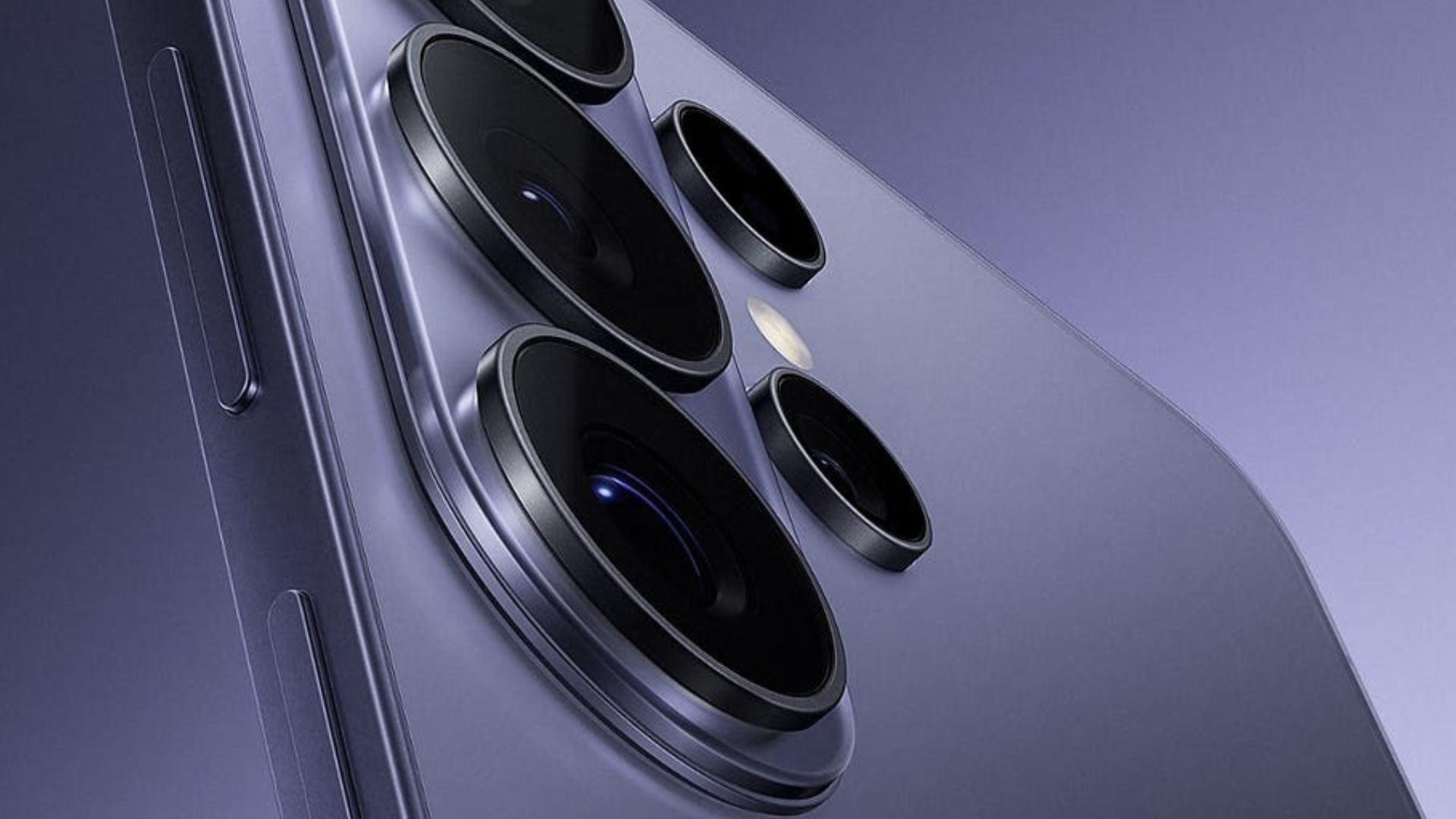
The Galaxy S26 Ultra’s 3x telephoto camera has emerged as a focal point of technical analysis. Leaks have long been inconsistent, but the dust is settling now. A recent discovery by Erencan Yılmaz points to a new 12MP sensor, the Samsung S5K3LD, with a native resolution of 4000×3000. However, reports suggest the company is only using a 10MP center crop for image capture, before reconstructing a final 12MP output through processing.
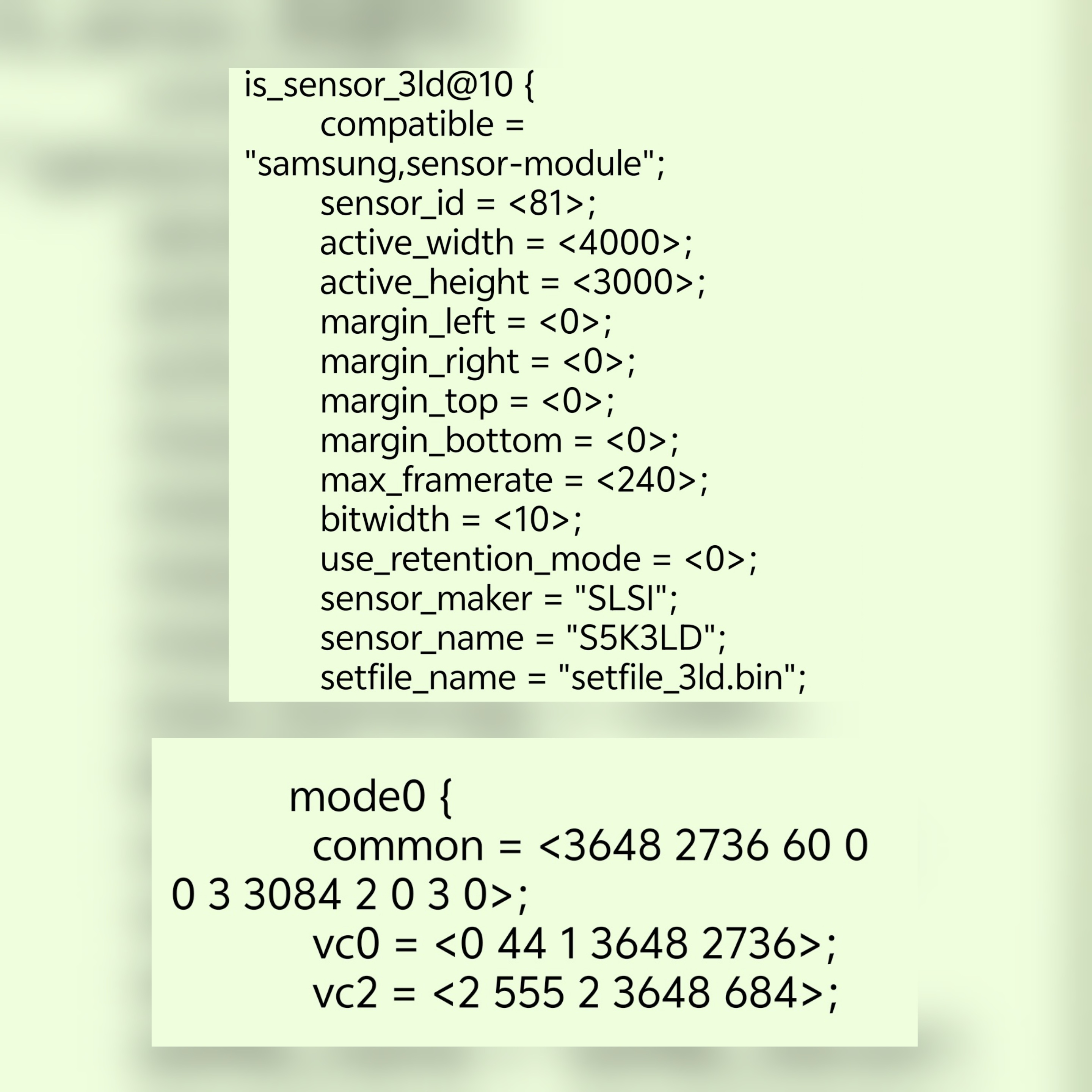
That raises a critical question: Is Samsung strategically optimizing speed and stabilization, or is the 3x module physically smaller than expected? To answer that, we need to look at the geometry behind the crop.
The Geometry Behind the Crop
The native resolution is 4000 x 3000. The reported effective crop is 3648 x 2736. That gives us a linear crop ratio: 3648 ÷ 4000 = 0.912.
Because the aspect ratio remains 4:3, this 0.912 factor scales width, height, and diagonal equally. And optical format — the 1/x” number — is based on diagonal measurement. So the crop reduces the effective optical size by that same 0.912 factor.
In simpler terms, if Samsung is using a 1/3.2” sensor, then applying the 0.912 crop gives: 3.2 ÷ 0.912 ≈ 1/3.5” effective. That would place it extremely close to the outgoing 3x module based on the Sony IMX754, which is 1/3.55”.
In this scenario, Samsung is not shrinking usable light area in any meaningful way. Instead, it is reserving part of the sensor as a stabilization and processing buffer. That makes engineering sense, especially if the S5K3LD is a stacked design with faster readout.
Cropping to the center can improve edge consistency, provide EIS margin, reduce rolling shutter, and enhance HDR stacking precision, all without materially sacrificing light-gathering compared to the previous generation. If the starting point is truly 1/3.2”, this looks like a calculated refinement.
But What If the Effective Area Is 1/3.94″?
Some reports claim the effective size is 1/3.94”. Reversing the math: 3.94 × 0.912 ≈ 1/3.6” native. That would mean the base sensor is already smaller than 1/3.2” before cropping. And once cropped, total photon capture drops further.
From a physics standpoint, that matters. Sensor area scales with the square of the diagonal. A move from 1/3.2” to 1/3.6” represents roughly a 25% reduction in total light area. That’s not trivial. At that point, the trade becomes harder to justify purely on hardware grounds. The system would rely more heavily on processing to compensate for reduced physical headroom.
Where the ISOCELL LD Family Fits
Samsung’s ISOCELL LD family has typically positioned itself around balanced mid-size telephoto sensors, often in the 1/3.x optical range with modern pixel isolation architecture. A 1/3.2” base size aligns more naturally with that positioning. A 1/3.6” base sensor cropped further to an effective 1/3.94” would feel less consistent with how Samsung has historically structured its telephoto hardware tiers. That doesn’t make it impossible, but it makes the size discrepancy worth questioning.
Physics vs Processing in 2026
It’s important to step back for a moment. Modern smartphone photography is no longer defined purely by optical format fractions. Readout speed, autofocus reliability, HDR stacking precision, and ISP integration often shape real-world results more than marginal diagonal differences.
If the new 3x module on the Galaxy S26 Ultra delivers faster focus lock, cleaner motion capture, more stable video, and improved portrait segmentation, then a strategic center crop may be entirely justified. However, if the effective area truly drops to 1/3.94”, the burden shifts more heavily toward computational processing to compensate for reduced physical light capture. And that’s where the debate becomes meaningful.
Here’s the unavoidable conclusion: A 12MP 4000×3000 sensor cropped to 3648×2736 produces a fixed 0.912 scale factor. As highlighted by Daebak in a separate analysis, the quoted 1/3.94” figure may stem from a different optical-format conversion method.
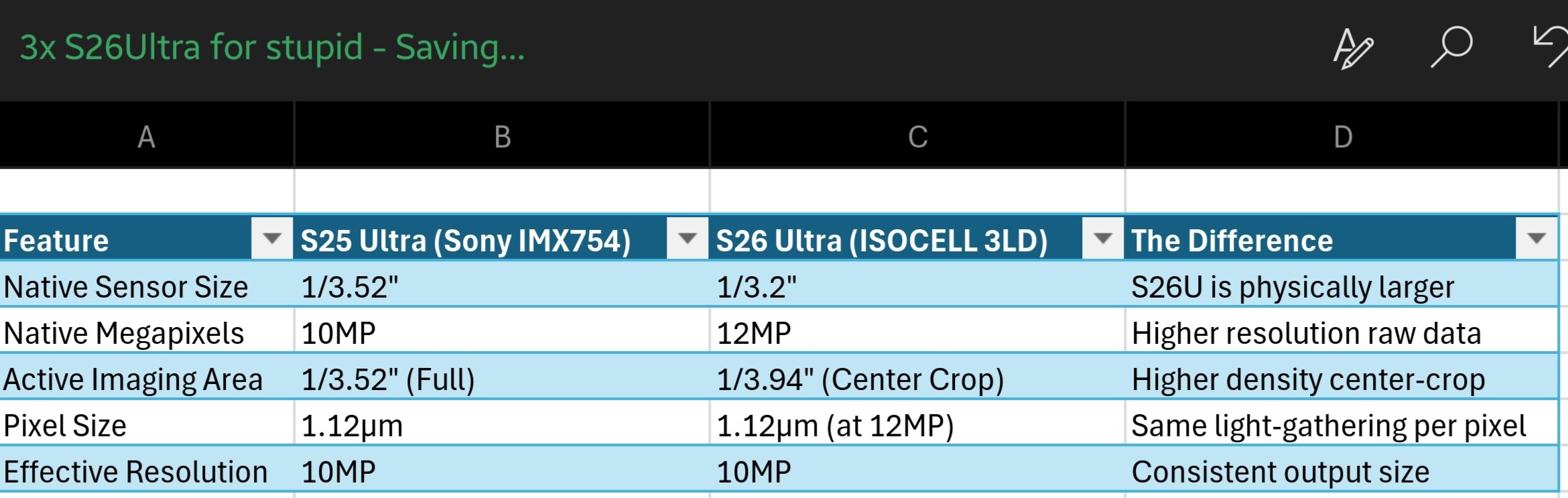
Under a strict 16mm constant, the following cannot all be simultaneously true:
- Native size = 1/3.2”
- Effective crop = 1/3.94”
Unless both figures are derived from differing optical-format naming conventions rather than actual physical diagonal differences.
In smartphone camera reporting, the “1/x” format is not always calculated using a rigid 16mm reference. Particularly for smaller telephoto modules, some spec sheets appear to apply a slightly higher effective constant when translating the physical imaging diagonal into its labeled format.
Using a higher constant can shift a sensor that mathematically aligns closer to ~1/3.5” (under a 16mm conversion) into the labeled range of ~1/3.9”, even when the underlying physical diagonal remains the same. If that is the case here, the discrepancy would be semantic rather than physical. Under that interpretation, Daebak’s calculation may also be internally consistent, depending entirely on which optical-format convention is applied.
The 3 scenarios
- If the difference between ~1/3.5” and 1/3.94” is purely the result of optical-format conversion methods, then image quality would not inherently change. The sensor’s light-gathering area is fixed, regardless of whether it is labeled ~1/3.5” under a 16 mm constant or ~1/3.94” under a slightly higher constant.
In that case, the physical imaging diagonal, pixel pitch, and total active area remain the same, meaning noise characteristics and dynamic range limits are defined by hardware, not by the fraction printed on a spec sheet. Only if the effective diagonal is physically smaller — not just differently labeled — would there be a measurable impact on low-light performance or dynamic range headroom.
- If the native sensor is indeed 1/3.2”, this appears to be a calculated engineering decision. It maintains a comparable usable light area while upgrading speed and system intelligence.
- If it is closer to 1/3.6” and then cropped further, the move becomes more controversial from a hardware standpoint.
Until Samsung publishes confirmed optical format, pixel pitch, and die measurements for the Samsung S5K3LD, this remains an open technical question.
It’s easy to reduce this discussion to optical format numbers, but real-world performance depends on more than diagonal measurements alone. A modern stacked architecture can significantly reduce rolling shutter. Faster readout improves HDR stacking consistency. More reliable autofocus, especially at 3x, may influence portrait performance more than a fractional change in sensor size.
Using a 10MP center crop could also allow Samsung to unify output resolution across lenses, optimize AI segmentation, and provide stronger stabilization without sacrificing final file size. So the real question becomes: If the output is cleaner, focuses faster, and handles motion better, would the unused 2MP really matter?
For now, the geometry is fixed. The confirmed specifications are not. When the final hardware details emerge, the numbers will settle the argument. Until then, this remains a question of physics, not perception. And as always in mobile imaging, execution matters more than fractions of an inch.


Follow us on Google Discover & set us as a preferred source in Google News
Share this Post
___________________________


New Blog Posts
___________________________
First Set of Pixel 11 Pro XL Renders Are Here
Pixel 11 Pro XL CAD renders show minimal design changes

Is Samsung Preparing One UI 8.5 Beta for Galaxy Z Fold 5 and Flip 5?
Samsung may launch a One UI 8.5 beta program for its 2023 foldables
Galaxy S25 One UI 8.5 Beta May Run Longer Than Expected
Galaxy S25 series’ One UI 8.5 beta may stretch to 10 rounds