Samsung Foldables Are Mature — Repair Policies Are Not
SammyGuru is reader-supported. We have affiliate and sponsored partnerships, so we may earn a commission when you buy through links on our site — at no extra cost to you. Learn more.
In this article
- A “black screen” isn’t always a broken screen
- What “OCTA” really means in repairs
- The OCTA policy becomes a long-term problem once batteries are involved
- Galaxy Z Flip 7 does slightly better, but not enough
- The $120 fix Samsung doesn’t offer
- The real issue: There is no middle ground
- Will Apple do better? Probably not
- What Samsung should change
Samsung foldables have already proven something important: they can last reasonably long. My Galaxy Z Flip 3 did. My Galaxy Z Flip 5 did too. Both survived more than two years of real-world use, thousands of folds, daily opening and closing, travel, heat, and the occasional accident.
During that time, Samsung Care+ worked exactly as promised. When my Flip 5 suffered a drop, and the hinge no longer closed perfectly, Samsung replaced the entire OCTA assembly — display, hinge, frame, and batteries — without hesitation. That experience proves one thing clearly: Samsung can support foldables well. The real problem begins after Samsung Care+ ends.
A “black screen” isn’t always a broken screen
Five months after my Samsung Care+ expired, my Galaxy Z Flip 5 developed an issue many foldable users will instantly recognize. The inner display went black. There were no cracks, no ink-like bleeding, and no visible dead pixels. The phone was still alive. It vibrated, received calls, and the cover display worked normally.
More importantly, when I gently opened or moved the hinge, the main display would briefly come back. That detail matters; behavior like this often means the OLED panel itself is not permanently damaged.
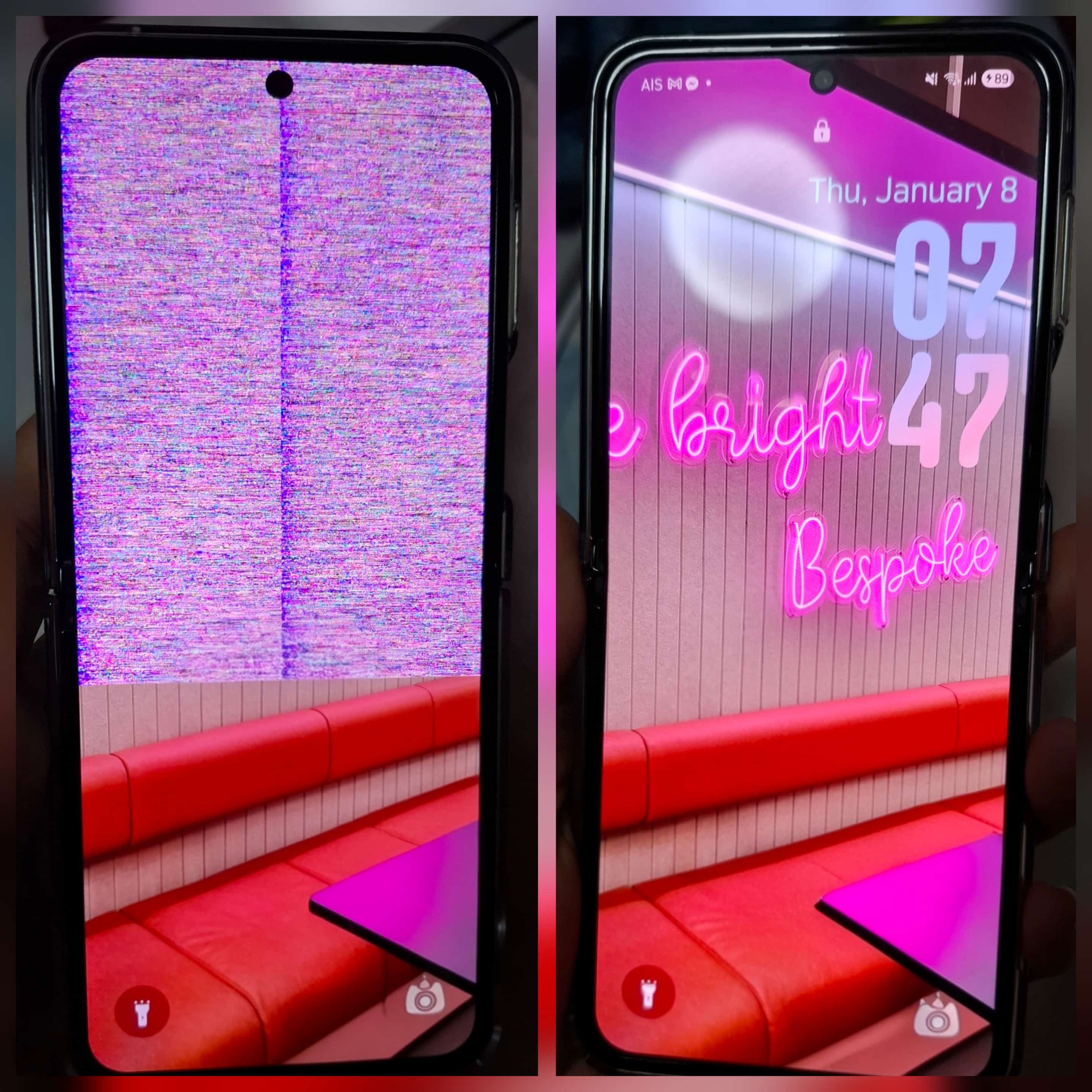
Based on real-world repair cases — including my own — this type of failure is frequently mechanical or electrical, not a dead display. Typical causes include:
- A stressed or partially loose flex (ribbon) cable running through the hinge
- Dust or debris buildup inside the hinge mechanism
- The phone is failing to correctly detect the “fully open” state, keeping the display asleep
This does not mean every black screen is fixable this way. But it does mean not every black screen equals a dead panel. Unfortunately, Samsung’s repair policy does not make that distinction. The official fix: Full OCTA Replacement.
At the authorized Samsung service center, the diagnosis was immediate: Full OCTA assembly replacement. The quoted price? Roughly 45% of the cost of a brand-new Galaxy Z Flip 7.
What “OCTA” really means in repairs
OCTA stands for On-Cell Touch AMOLED, but in repair reality, it means replacing almost the entire phone. An OCTA replacement includes:
- The foldable OLED display
- The hinge mechanism
- The full metal frame/chassis
- The batteries, which are often replaced because of how tightly they’re integrated
Even if the real issue is something minor — a cable connection or hinge contamination — the solution treats it as a total system failure. It’s fast for technicians. It guarantees factory-level sealing. But it’s financially devastating once you’re out of warranty.
The OCTA policy becomes a long-term problem once batteries are involved
This problem goes beyond screens and hinges. Even if a foldable has zero display or hinge issues after two years, it still faces an unavoidable reality:
- Battery aging
- Battery degradation
- Capacity drops
- Internal resistance increases
- Heat buildup becomes more likely
- Swelling risk rises
On traditional slab phones, this is a routine maintenance issue. On foldables, it can become a device-ending event.
Galaxy Z Flip 7 does slightly better, but not enough
With the Galaxy Z Flip 7, Samsung has made a small but meaningful improvement. The dual battery modules now use pull tabs and less adhesive, allowing trained technicians to replace them more easily than on older Flip models. However, there’s a critical catch.
Samsung itself states that water resistance diminishes over time, and once a foldable is opened for internal service, the original factory-certified IP sealing cannot be fully guaranteed or revalidated.
So even when a battery replacement is done at an official Samsung service center, restoring full IP water and dust resistance is not guaranteed. Long-term durability becomes uncertain. Because of this, Samsung often still prefers or defaults to full OCTA replacement if maintaining IP protection is a priority.
On older foldables, the situation is even worse:
- Batteries are often glued directly into the frame
- Structurally tied to the hinge and OCTA assembly
Out of warranty, Samsung frequently does not offer a simple battery-only replacement. Instead, battery degradation can trigger the same outcome as a display failure: a massive bundled repair quote.
This means a foldable that still folds perfectly, has a working display, and shows no hinge damage can effectively become e-waste because of a consumable part. That’s not a battery problem. That’s a design-for-replacement problem.
The $120 fix Samsung doesn’t offer
Unwilling to pay nearly half the price of a new phone for a device that clearly wasn’t beyond repair, I took my Flip 5 to a reputable independent repair shop. Before choosing independent repair, I treated the issue as a test. Since gently moving the hinge repeatedly brought the main display back for a few seconds, it strongly suggested a mechanical issue rather than a dead OLED panel. That behavior is what led me to try a targeted repair instead of a full OCTA replacement.
The result? $120 and a fully functional Flip 5 again.
- No display replacement
- No hinge replacement
- No battery replacement
The fix likely involved:
- Cleaning debris from the hinge
- Reseating internal flex cables
- Realigning components so the phone correctly detects the open state
The most expensive part — the OLED display — remained untouched. Yes, this kind of repair can compromise water resistance. But it saved a perfectly good foldable from unnecessary replacement.
Important: If your device is still under warranty or covered by Samsung Care+, do not use an independent repair shop. Unauthorized service will void your coverage and compromise the IPX8 rating. In that case, let Samsung handle it.
The real issue: There is no middle ground
Samsung’s foldable repair model is effectively binary:
- Under Samsung Care+ → comprehensive replacement at a manageable cost
- Out of Samsung Care+ → comprehensive replacement at a devastating cost
There is no official middle-ground service for: Hinge cleaning or maintenance, cable reseating, sensor recalibration, and battery-only replacement with realistic IP expectations. Foldables have matured, but repair policies have not.
Will Apple do better? Probably not
With a foldable iPhone widely expected later this year, some believe Apple will fix these problems. But history suggests otherwise. Apple is known for serialized parts, restricted third-party repairs, whole-unit replacement strategies, and heavy dependence on AppleCare+.
Even if Apple’s hinge design proves more durable, repairability is unlikely to improve. Durability and repairability are not the same thing, and neither company has truly embraced the latter.
What Samsung should change
Samsung doesn’t need weaker OCTA assemblies. It needs repair tiers. A mature foldable ecosystem should include:
- Official hinge cleaning and maintenance
- Cable reseating and sensor recalibration
- Battery replacement without replacing the display
- Honest, transparent post-warranty pricing
- Realistic IP expectations instead of forced full replacements
If an independent shop can restore a foldable for $120 by cleaning and reseating parts, Samsung should be able to offer a factory-approved maintenance service for loyal users. Because right now, the message to foldable owners is clear: Your foldable can survive for years, but once something small goes wrong, the repair policy decides its fate.


Follow us on Google Discover & set us as a preferred source in Google News
Share this Post
___________________________


New Blog Posts
___________________________
First Set of Pixel 11 Pro XL Renders Are Here
Pixel 11 Pro XL CAD renders show minimal design changes
Is Samsung Preparing One UI 8.5 Beta for Galaxy Z Fold 5 and Flip 5?
Samsung may launch a One UI 8.5 beta program for its 2023 foldables
Galaxy S25 One UI 8.5 Beta May Run Longer Than Expected
Galaxy S25 series’ One UI 8.5 beta may stretch to 10 rounds