Samsung Foundry Gets Second Chance as TSMC Bottlenecks Deepen
SammyGuru is reader-supported. We have affiliate and sponsored partnerships, so we may earn a commission when you buy through links on our site — at no extra cost to you. Learn more.
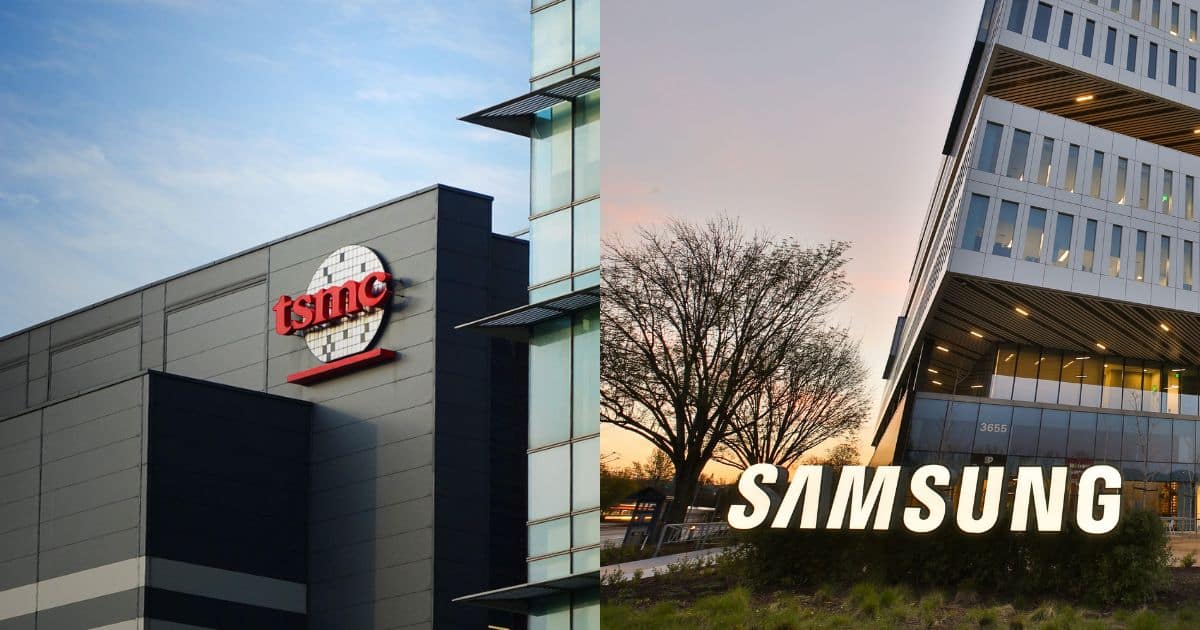
For years, Samsung has been in TSMC’s shadow in the foundry business. The numbers are clear: TSMC controls over 70% of the global market, while Samsung Foundry remains below the 10% mark. However, this imbalance may soon change. Experts believe that Samsung Foundry’s position will improve in the next two to three years. They won’t dethrone TSMC, but they could become an important alternative for high-end AI silicon.
As noted by semiconductor expert @jukan05, this shift stems from a growing realization among fabless companies. TSMC is not just limited by advanced packaging; its front-end is becoming a bottleneck as well. This situation, combined with aggressive pricing and slight gains in PPA, is creating a rare chance for Samsung to position itself as a serious option for front-end manufacturing, with Intel stepping in as a partner for back-end processes.
As capacity tightens and costs rise, more chipmakers are reconsidering the risk of relying on a single supplier. Tesla’s choice to split its next-generation Dojo AI6 chips between Samsung for front-end manufacturing and Intel for advanced packaging may serve as the first solid proof of this new approach.
TSMC’s bottleneck is deeper than CoWoS
While TSMC remains the top player in advanced logic, its advantages in scale are increasingly under pressure. The industry has focused largely on CoWoS shortages, but issues now affect the whole manufacturing chain. TSMC is rapidly expanding CoWoS capacity, increasing from tens of thousands of wafers per month in 2023 to an estimated 70,000 to 80,000 wafers per month by late 2025.
Still, demand from NVIDIA, hyperscalers, and AI ASIC suppliers continues to outstrip supply. Lead times remain long, and AI chip shipments will be capacity-limited at least until 2025. More critically, front-end capacity at 3nm and 2nm is effectively fully booked. Apple and a few major customers have secured most of the early wafers, leaving little space for others.
This means that simply moving packaging work away from TSMC while still using its wafers does not fix the problem. There aren’t enough leading-edge dies available for packaging. Consequently, TSMC maintains strong pricing power, and customers have less flexibility.
Fabless firms question the PPA-to-Price equation
As AI demand has surged, TSMC has moved toward what many observers now call near-monopoly pricing at its most advanced nodes. Recent comments about the supply chain reveal combined pressures on fabless companies:
- Sub-5nm wafer prices have increased by about 3-5%
- 3nm availability is limited
- 2nm allocations are highly concentrated and selective
At the same time, PPA improvements across nodes aren’t scaling as they used to, especially considering rising design complexity, Non-Recurring Engineering costs, and longer development cycles. For some customers, the total cost of ownership is rising faster than the benefits. This widening gap is causing fabless firms to look for alternatives. They might not completely abandon TSMC, but they are certainly trying to reduce reliance on a single supplier that is gaining more leverage.
Samsung Foundry stands to benefit
Samsung Foundry still trails TSMC significantly in market share, and its issues with yields and execution at earlier nodes have hurt customer confidence. However, 2025 represents a unique moment of external pressure on TSMC and internal progress at Samsung. Reports indicate that 3nm GAA yields are stabilizing, along with heavy investments in capacity in Korea and the U.S., including Pyeongtaek and Taylor, Texas.
While Samsung may not yet match TSMC’s overall maturity, it can now offer something highly valuable: more competitive pricing at advanced nodes. The company is also committed to reserving significant capacity for strategic AI customers. Additionally, customers gain access to an integrated portfolio that includes logic, memory, and advanced packaging.
Samsung’s geographic diversification, including manufacturing in the U.S., is another advantage. For AI system designers looking for supply-chain resilience and political risk management, Samsung’s expanding U.S. operations provide additional appeal.
Tesla’s AI6 decision breaks the single-vendor mold
Tesla’s Dojo AI6 program is now regarded as Samsung Foundry’s largest external design win, reportedly worth over $16 billion in long-term business. Under this deal, Samsung Foundry produces the AI6 dies while Intel Foundry Services handles the advanced packaging, likely using EMIB-based 2.5D integration. This approach departs from the standard “TSMC front-end + TSMC CoWoS” model found in today’s AI accelerators.
Dojo’s design uses ultra-large tiles and dense on-package interconnect, making it particularly suitable for this split approach. By combining Samsung wafers with Intel packaging, Tesla reduces the risks associated with supply-chain concentration and avoids being stuck behind NVIDIA and hyperscalers in TSMC’s capacity queue. More broadly, it shows that front-end and back-end processes do not need to come from the same vendor anymore.
ASICs may move ahead of GPUs
While Tesla’s move is important, it is unlikely that NVIDIA or AMD will follow suit quickly. Both companies rely on well-optimized TSMC processes, mature libraries, and reliable yields across extensive product lines. For them, switching foundries involves a multi-billion-dollar risk. ASIC manufacturers, on the other hand, often work with more focused volumes and system-level optimization goals. For these clients, a dual-foundry strategy might make sense if it ensures guaranteed capacity, pricing power, and long-term independence.
Signs already indicate that multiple fabless firms are evaluating Samsung’s 3nm and 2nm nodes either as a secondary option or as a primary supplier for upcoming designs. In these cases, Intel’s EMIB and Foveros technologies become neutral, interchangeable packaging layers, further weakening TSMC’s one-stop-shop advantage.
Whether the “Samsung front-end + Intel back-end” model becomes a lasting trend will depend on several factors. Samsung needs to consistently deliver yields and credible PPA at 3nm GAA, then smoothly transition to 2nm. Intel must also show that its EMIB and 3D packaging services are reliable and cost-effective for AI accelerators at scale. Meanwhile, TSMC’s need to quickly normalize its CoWoS and future packaging capacity could make this shift less appealing.
However, if TSMC continues to face ongoing oversubscription while prices rise, the urge to diversify will only increase. If that doesn’t happen, many customers might still prefer the comfort of established suppliers. Either way, the long-standing narrative of “TSMC versus everyone else” is starting to change. By 2026, Samsung Foundry may no longer be an afterthought; it could become a necessary alternative in the AI silicon supply chain.

Written by
Sumit AdhikariSumit, a life-long Samsung user, is passionate about technology and has been professionally writing on tech since 2017. He’s a mathematics graduate by education and enjoys teaching basic mathematics tricks to school kids in his spare time. Sumit believes in artificial intelligence and dreams of a fully open, intelligent and connected world.

Follow us on Google Discover & set us as a preferred source in Google News
Share this Post
___________________________


New Blog Posts
___________________________

First Set of Pixel 11 Pro XL Renders Are Here
Pixel 11 Pro XL CAD renders show minimal design changes

Is Samsung Preparing One UI 8.5 Beta for Galaxy Z Fold 5 and Flip 5?
Samsung may launch a One UI 8.5 beta program for its 2023 foldables
Galaxy S25 One UI 8.5 Beta May Run Longer Than Expected
Galaxy S25 series’ One UI 8.5 beta may stretch to 10 rounds