
Samsung Plans Major 2nm Capacity Boost as It Challenges TSMC
SammyGuru is reader-supported. We have affiliate and sponsored partnerships, so we may earn a commission when you buy through links on our site — at no extra cost to you. Learn more.
Samsung is confident that it will attract clients around the globe with its next-gen 2nm process. Industry analysts expect the company may be able to significantly increase the production capacity of this process by the end of next year. This shows the firm’s push to challenge industry leader TSMC in advanced semiconductor technology.
Samsung plans to expand its 2nm process production capacity
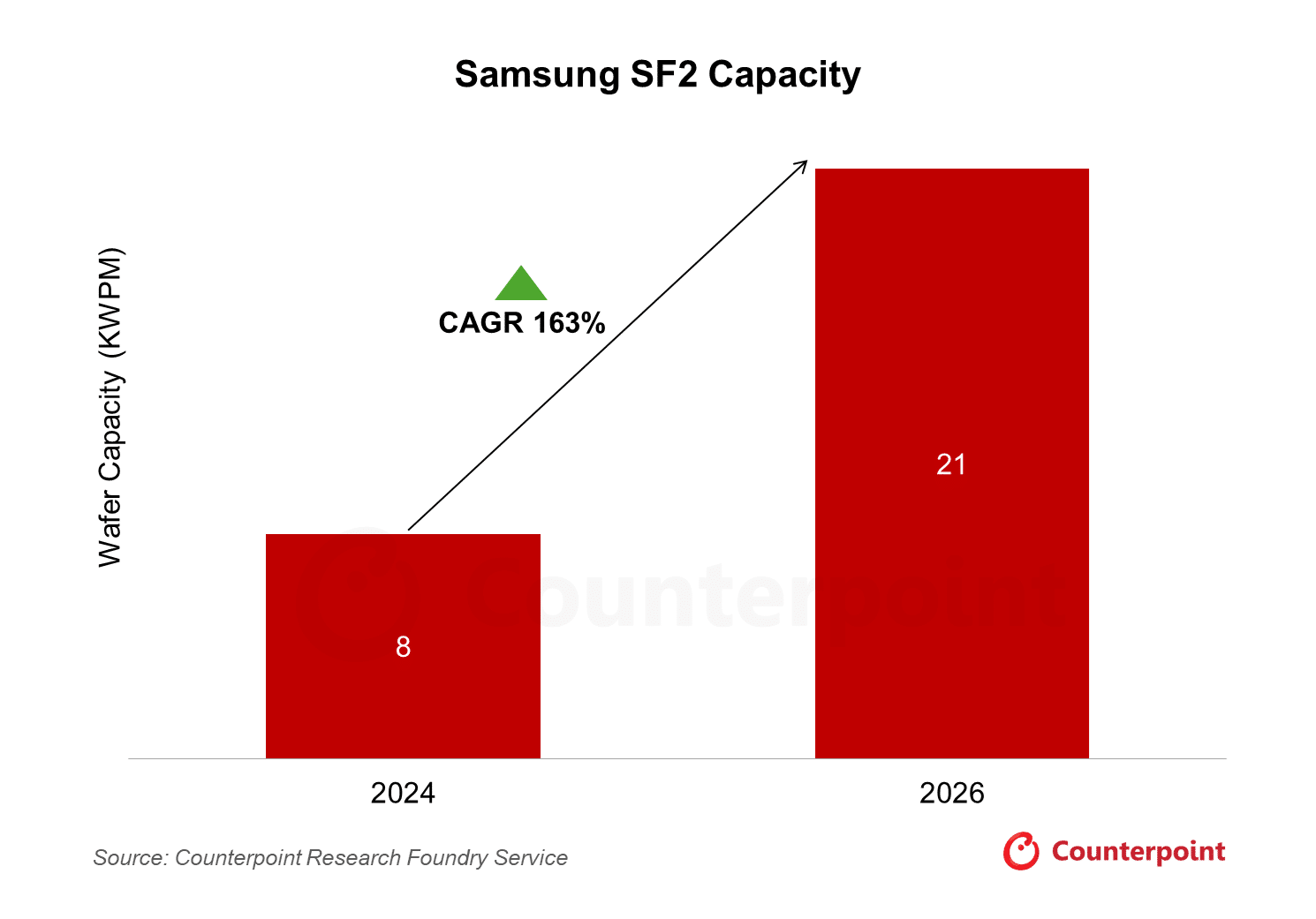
According to a report from Counterpoint Research, Samsung’s 2nm production capacity could reach about 21,000 wafers per month by the end of 2026. In 2024, the company’s targeted output was around 8,000 wafers per month, meaning it could achieve 163% growth in just two years. The report also says that this expansion is because of the accelerated R&D investment, improved process control, and early collaboration with key customers.
Samsung has been trying to narrow the gap (in terms of both revenue and market share) with TSMC for several years. Industry watchers expect the company’s 2nm process may play a big role in this effort. “If yield stability continues to improve and mass production at its Taylor fab in the US proceeds smoothly, Samsung could meaningfully narrow the competitive gap with TSMC in leading-edge processes for the first time in several generations,” noted the research firm.
Samsung recently revealed the first results from mass production of its 2nm process, and the improvements are promising. Built on Gate-All-Around (GAA) technology, the process delivers a 5% performance increase and an 8% improvement in power efficiency compared to its 3nm technology. This suggests that the cutting-edge process is maturing well and could provide a competitive edge as production ramps up.
Samsung’s own System LSI division could be the first to adopt its in-house 2nm process with the Exynos 2600. The chip will likely power the upcoming Galaxy S26 and Galaxy S26+ in most markets (excluding the United States, Japan, and China). This could give the company an advantage, as it can internally improve the technology before expanding it to key external customers such as Tesla.

Written by
Binay KonwarBinay Konwar started his blogging journey in 2014 and has since written plenty of tech articles. At present, he is working as a News Writer at SammyGuru, covering everything about Samsung. He holds a Master's degree in Mathematics, but his real passion lies in tech and writing. In his free time, he enjoys playing chess and watching movies.

Follow us on Google Discover & set us as a preferred source in Google News
Share this Post
___________________________


New Blog Posts
___________________________

First Set of Pixel 11 Pro XL Renders Are Here
Pixel 11 Pro XL CAD renders show minimal design changes

Is Samsung Preparing One UI 8.5 Beta for Galaxy Z Fold 5 and Flip 5?
Samsung may launch a One UI 8.5 beta program for its 2023 foldables
Galaxy S25 One UI 8.5 Beta May Run Longer Than Expected
Galaxy S25 series’ One UI 8.5 beta may stretch to 10 rounds