
Samsung and POSTECH Advance Metalens Tech for Future Galaxy Cameras

SammyGuru is reader-supported. We have affiliate and sponsored partnerships, so we may earn a commission when you buy through links on our site — at no extra cost to you. Learn more.
Samsung and Pohang University of Science and Technology (POSTECH) have achieved a major leap in ultra-compact metalenses technology. In the future, this will help OEMs reduce smartphone camera bumps and lower the weight of extended reality (XR) devices. Their research paper titled “Compact eye camera with two-thirds wavelength phase-delay metalens” has been published in Nature Communications.
Next-generation metalens promises slimmer and lighter devices
Samsung adopted a comprehensive strategy to show the capabilities of next-generation photonic device technologies. Dr. Jeong-Geun Yun from Samsung Research and Professor Junsuk Rho from POSTECH led the study, with Hyunjung Kang from POSTECH as co-first author. Their research shows a solution for long-standing technical limitations about metalenses.
“Metalenses have been difficult to commercialize due to complex fabrication and low mechanical stability. To overcome this, we collaborated with experts in design, simulation, manufacturing and validation to develop a new nanostructure design method,” said Dr. Jeong-Geun Yun, Samsung Research.
A metalens is an ultra-thin lens that uses nanostructures to control light. Unlike traditional lenses that rely on curved surfaces, metalenses are arranged on a flat surface. This is a perfect solution to develop compact and lightweight optical devices. However, there are some challenges in commercialization as a metalens must create a phase delay of one wavelength.
This delay ensures light waves overlap properly at the focal point to create a sharp image. But achieving it requires building tens of millions of very thin and tall nanostructures, with aspect ratios of at least 1:10. These structures are difficult to build and fragile, making them unfit for mass production.
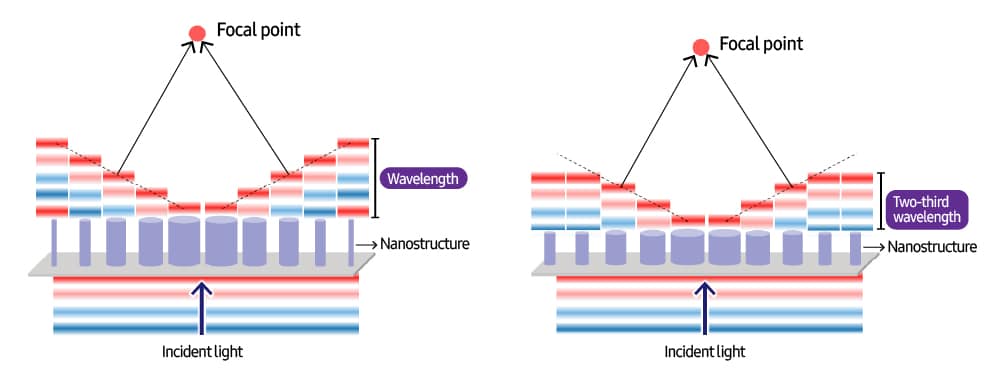
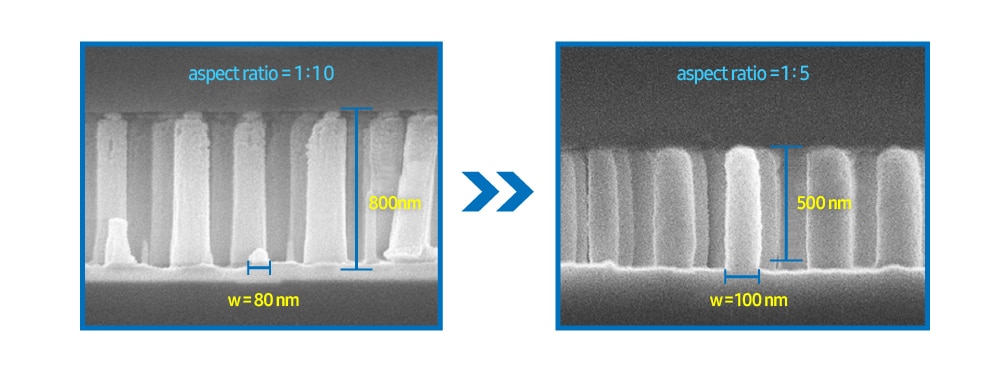
However, Samsung and POSTECH have come up with a new method that uses a phase delay of only two-thirds of a wavelength instead of a full wavelength. This approach keeps the wavefront stable in the far field and reduces the nanostructures’ aspect ratio to about 1:5. As a result, it reduces manufacturing defect rates, improves structural stability, and boosts production.
The team used this technology to build an ultra-compact infrared eye camera for XR devices. The new camera was 20% thinner than conventional refractive-lens cameras, shrinking from 2.0 mm to 1.6 mm. It achieved a wide 120-degree field of view with precise gaze tracking and iris feature-point recognition. Furthermore, the modulation transfer function (MTF) performance improved from 50% to 72%.

Written by
Binay KonwarBinay Konwar started his blogging journey in 2014 and has since written plenty of tech articles. At present, he is working as a News Writer at SammyGuru, covering everything about Samsung. He holds a Master's degree in Mathematics, but his real passion lies in tech and writing. In his free time, he enjoys playing chess and watching movies.

Follow us on Google Discover & set us as a preferred source in Google News
Share this Post
___________________________


New Blog Posts
___________________________

First Set of Pixel 11 Pro XL Renders Are Here
Pixel 11 Pro XL CAD renders show minimal design changes

Is Samsung Preparing One UI 8.5 Beta for Galaxy Z Fold 5 and Flip 5?
Samsung may launch a One UI 8.5 beta program for its 2023 foldables
Galaxy S25 One UI 8.5 Beta May Run Longer Than Expected
Galaxy S25 series’ One UI 8.5 beta may stretch to 10 rounds